
Western Azerbaijan
Talin Fortress
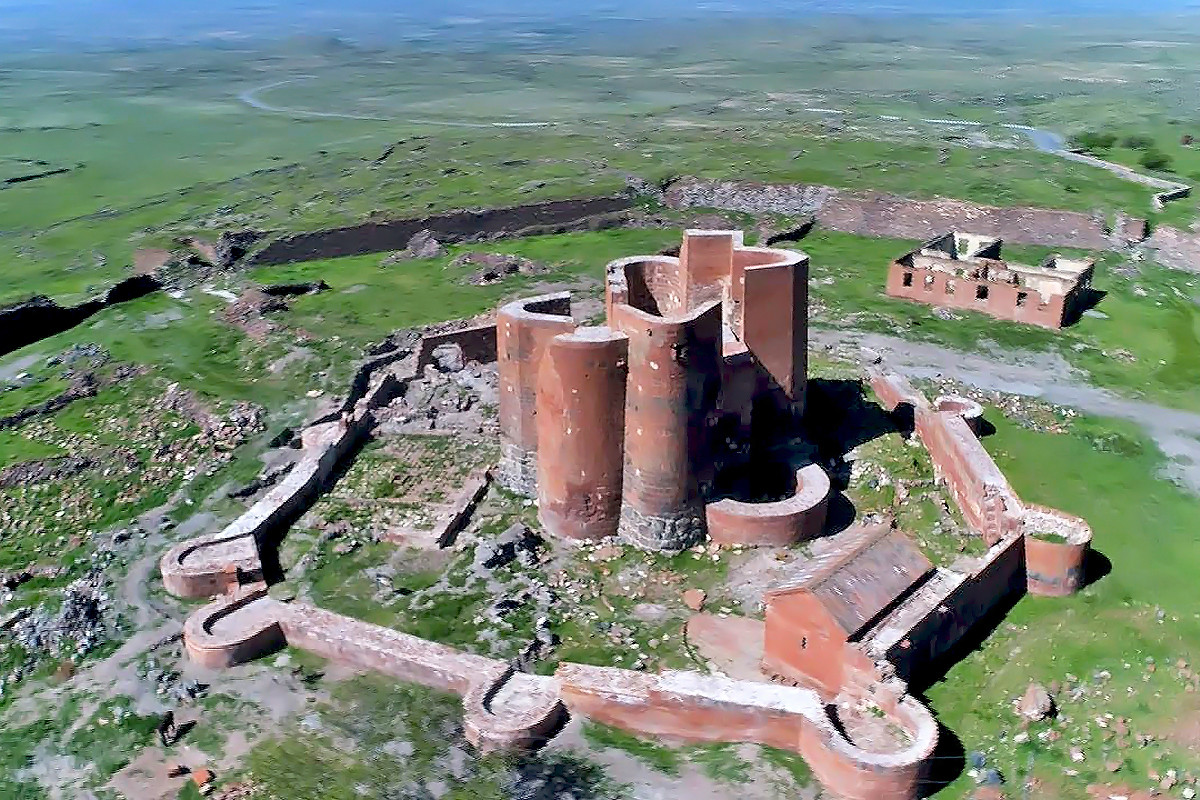
The Talin district, where the fortress is located, was situated geographically in the northwestern part of the Iravan Khanate, on the southern foothills of Mount Alagöz (Ələyəz). Talin Fortress lies on the southern outskirts of the ancient village formerly known as Aşağı Talın (Lower Talin), now referred to by Armenians as Dashtadem. It is located 4.5 km from the town once called Yuxarı Talın (Upper Talin), currently known as Talin, and approximately 65 km from the city of Iravan. The fortress complex consists of two main sections: the Inner Fortress (İçqala, also known as Narınqala) and the Outer Fortress (Bayırqala). An inscription in Arabic Kufic script on the eastern wall of the Inner Fortress records that it was built in 1174 by Sultan Shahanshah, son of Shaddadi emir Mahmud. The inscription contains seven lines, though the last three lines have become illegible over time.
The term “Talın”, which in ancient Turkic meant “a place with willows,” was later altered by Armenians and replaced with the word “Talin”, which today carries no clear or meaningful interpretation.
Bayirqala was built in 1812 by the last Khan of Iravan, Huseyngulu Khan Qajar, as a defensive measure to block Russian advances toward Iravan. The outer fortress, Bayirqala, consisted of 15 bastions, each equipped with cannons. The inner fortress (İçqala) comprised 8 bastions. In 1826, Russian forces captured the Lower Talin Fortress. Following this, Armenian families fleeing from the Ottoman Empire settled first around Bayirqala and later within it. Until 1918, the Talin Fortress remained the property of Ibrahim Khan and his relatives. In May 1918, as Armenian bandit groups retreated ahead of the advancing Turkish army, they attacked Talin Fortress and massacred most of the Azerbaijani residents living there. Only a few managed to escape and flee to Kars.
In an attempt to justify their claim over the Talin Fortress, Armenians later constructed a temple within the Inner Fortress (İçqala).
In recent years, partial restoration and repair works have been carried out within the fortress.
During ancient and medieval times, the city of Talin was located along major caravan routes, and a large caravanserai was built nearby. Today, the Talin caravanserai stands in a semi-ruined condition.