
Western Azerbaijan
Erebuni Fortress
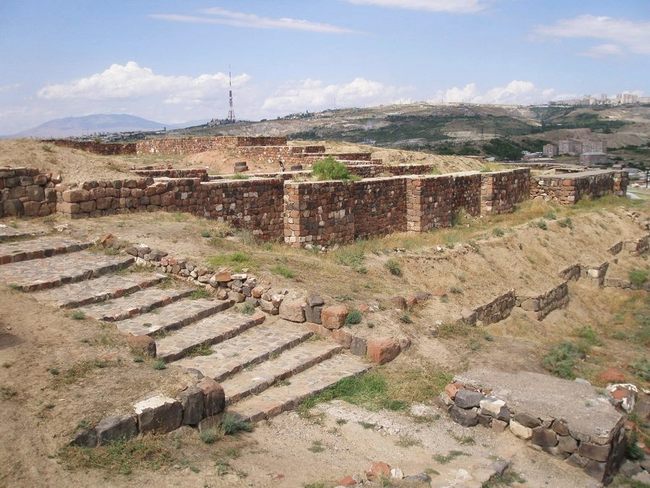
Armenian historians attempt to link the name of the city of Iravan to the Erebuni (also referred to as Irpuni) Fortress, which was built during the reign of the Urartian king Argishti I in 782 BCE. However, the Erebuni Fortress was constructed solely for military and fortification purposes, and no urban infrastructure ever developed around it. This hill, known by the local Azerbaijani population as “Qanlı Təpə” (“Bloody Hill”) and currently referred to by Armenians as “Arinberd” (translated from Armenian as “Bloody Fortress”), is located to the southeast of present-day Iravan.
In 1879, Russian archaeologist A. Ivanovsky discovered a basalt stone in the village of Cholmakchi near Iravan, bearing cuneiform inscriptions dating back to the reign of the Urartian king Argishti I. Subsequently, several more stones with cuneiform inscriptions were found in the same area.
Cuneiform inscriptions attributed to the Urartians and found on “Qanlı Təpə” reveal that in the first quarter of the 8th century BCE, before the Urartian occupation of the Ağrı Valley (the left bank of the Araz River and the lower course of the Arpachay River), the region was known as the land of the Aza people.
The identification of the city of Iravan with the Erebuni (Irpuni) city founded by Urartian King Argishti I is a clear example of historical falsification by Armenian historians. During archaeological excavations carried out in 1950 on Qanlı Təpə, a basalt stone bearing cuneiform inscriptions was discovered. The inscription contained the sequence “RBN,” which Armenian researcher G. Kapanchyan was the first to interpret as “Erebuni.” He then proposed the idea that this name might be etymologically connected to “Yerevan.” Academician Boris Piotrovsky’s hypothesis — “It is possible that the name of the Urartian city Erebuni continues to live on in the name of the Armenian capital, Yerevan” — gave Armenians the pretext to celebrate the 2750th anniversary of Yerevan in 1968. With this, Armenians proclaimed to the world that the city of Iravan was supposedly about 30 years “older” than ancient Rome.
The Iravan settlement, which began to develop into a city only in the medieval period, is located at a considerable distance from the Erebuni Fortress unearthed during archaeological excavations in 1950. Despite the fact that the city of Iravan has expanded multiple times over the years, there still remains a significant distance between the city and Qanlı Təpə, the site of the Erebuni Fortress.
Just as the Urartians have no historical connection to the Armenians, the ancient Erebuni Fortress has no spatial or historical relation to the present-day city of Iravan.