

Western Azerbaijan
Baligli Mosque
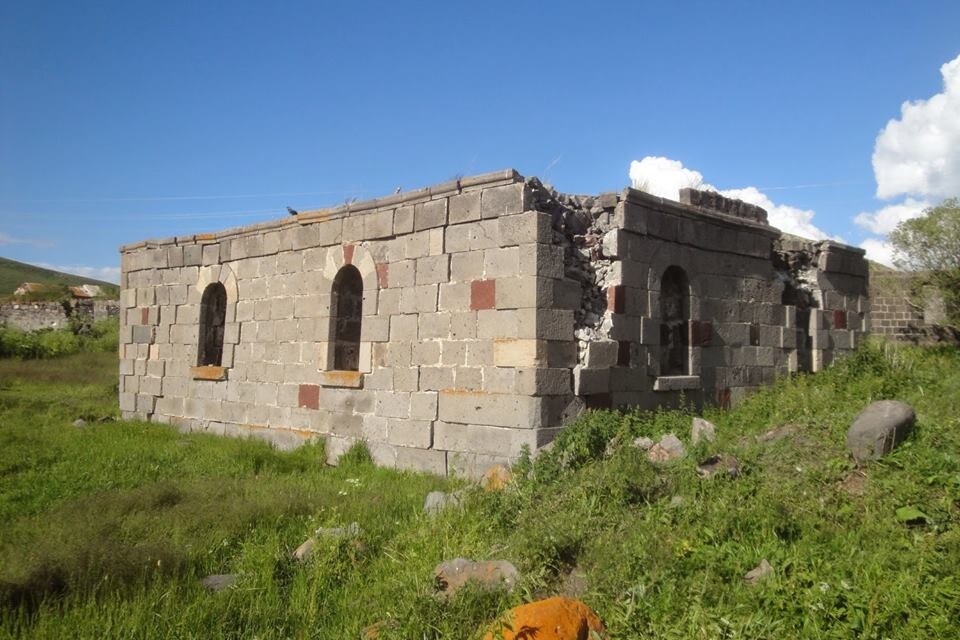
During the 19th century, mosques built in the villages of Okhchoglu, Gullubulag, Garachanta, and Gollu of the Aghbaba district (later Amasiya region) in Western Azerbaijan were converted into collective and state farm warehouses starting in the 1930s under Soviet rule, while mosques in other villages were entirely destroyed.
The Baligli village mosque, for which color photographs were recently obtained, was built in the late 19th century and situated on the shore of Lake Arpa. It featured distinctive architecture, with walls built from squared stones in white, gray, blue, and red colors. Its dimensions were approximately 10 meters long and 5 meters wide. Built in the style of residential architecture, it had two oval-shaped windows at the upper rear side, and at the front, a single window and a wide entrance door. Dark yellow marble stones were placed below windows both inside and outside. Its inscription was originally located on an interior wall between two windows but is now illegible.
The mosque, currently semi-ruined, has severely cracked walls. The Azerbaijani population of Baligli was deported from Armenia in 1988-1989. On April 3, 1991, the Armenian parliament renamed Baligli village as "Zorakert."