
Western Azerbaijan
Selim Caravanserai
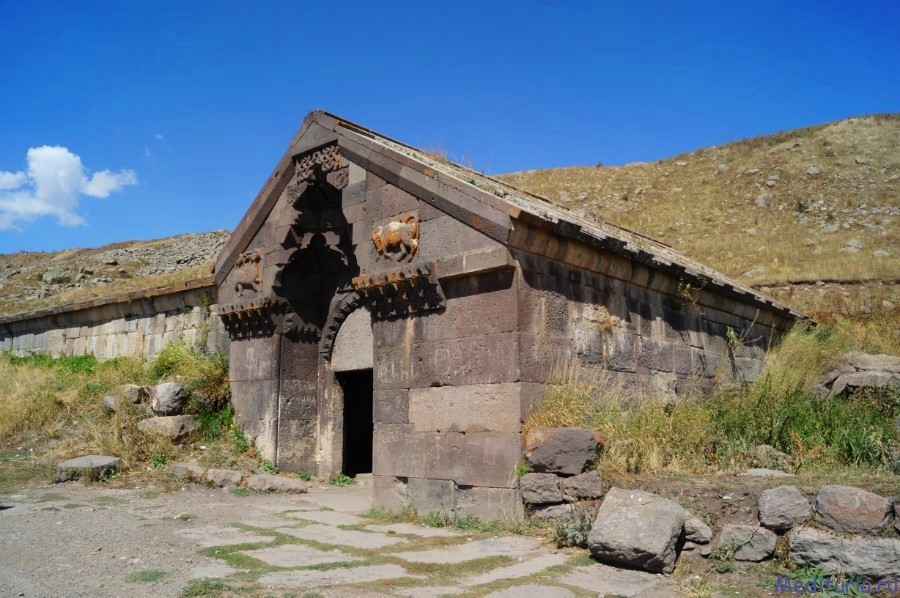
Selim Caravanserai is located in the Daralayaz district, within the territory of Keshishkand (renamed Yeghnadzor since December 6, 1957), near the village of Aghkand (renamed Aghdzanadzor since July 3, 1968), at an elevation of 2,410 meters on the Selim Pass of Alagoz (Alayaz) Mountain. Officially known as Selim Caravanserai due to its location on Selim Pass, it was popularly referred to by locals as Shah Abbas Caravanserai.
Built from finely cut basalt stones, the caravanserai consists of two structures. The main building, measuring 35.5 meters in length and 5 meters in width, extends from north to east. The second building, measuring 31.5 meters in length and 14.7 meters in width, was constructed perpendicular to the main building.
Above the caravanserai’s entrance is a semicircular Arabic inscription (2 meters wide and approximately 1 meter high at its center) stating that the caravanserai was constructed in 1328–1329 during the reign of Abu Said Khan Bahadur (a descendant of Chinghis Khan, who ruled the Elkhani state from 1316–1335).
Until 1918, the nearby village of Aghkand was inhabited exclusively by Azerbaijanis. Armenians first settled in this village between 1923 and 1925.
Armenians, however, attempt to claim the caravanserai as an Armenian historical monument, asserting that it was built during the reign of the so-called "Armenian prince" Chesaré Orbelian.