
Western Azerbaijan
The Blue Mosque
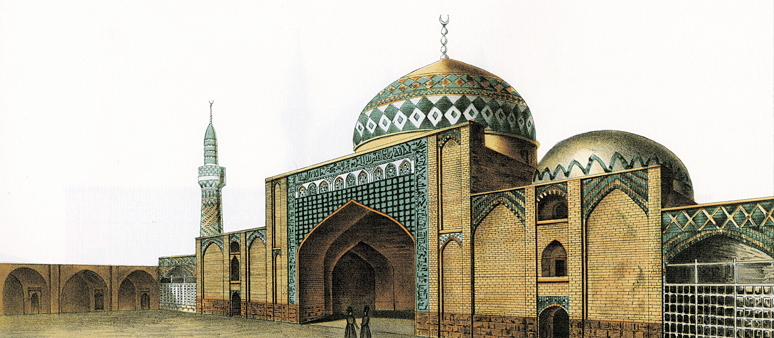
All travelers and researchers describing the city of Iravan prominently highlight the Blue Mosque (also known as Huseynali Khan Mosque) as the city's most magnificent architectural monument due to both its grand scale and beauty. The Blue Mosque in Iravan was the largest mosque in the Caucasus.
Construction of the Blue Mosque, regarded as one of the rare examples of Eastern architecture, began in 1760 during the rule of Huseynali Khan Qajar and was completed in 1766. Situated opposite the "Covered Bazaar" in the city center, the mosque measured 97.2 meters by 66 meters. The mosque's name originated from its dome, decorated with blue tiles. In its courtyard stood a stone pool with fountains, surrounded by densely shaded trees.
From 1936, the Blue Mosque building housed the Iravan City History Museum. During World War II, it temporarily served as an ammunition warehouse. After the war, the mosque housed the Museum of Nature, and from 1952, its small prayer hall functioned as a Planetarium for astronomy enthusiasts.
Following Armenia’s independence and establishment of diplomatic relations with Muslim countries, the Museum of Nature was moved out of the mosque complex in 1991, followed by the History Museum in 1994. According to an agreement signed between Iran and Armenia in 1995, the Iranian government took responsibility for financing the mosque's restoration, with completion in 2006. Restoration work focused only on the mosque complex's southwestern and northern sections, reconstructing the 24-meter minaret, 28 cells, library, great hall, dome, and courtyard.
In a meeting held on December 10, 2015, the Armenian government decided to transfer the Blue Mosque and its territory to the Embassy of the Islamic Republic of Iran in Armenia for 99 years, free of charge, to be used as a cultural center. Today, Armenian officials present the Blue Mosque to foreign visitors as a "Persian Mosque."