
Western Azerbaijan
Iravan Fortress
The earliest written records about the Iravan Fortress date back to the Safavis era. In 1502, Shah Ismail’s forces, the Safavis state’s ruler, defeated the Qaraqoyunlu emirs and seized the city of Iravan. The renowned 17th-century Turkish traveler and geographer Evliya Chelebi, who visited the South Caucasus in the 1640s, wrote that Shah Ismail instructed his vizier, Ravangulu Khan, in the year 915 AH (1509–1510 CE) to build a fortress. Following this order, Ravangulu Khan completed the construction of the fortress within seven years and named it “Ravan.”
In 1514, following the Battle of Chaldiran between Safavi ruler Shah Ismayil and Ottoman Sultan Selim, the Iravan Fortress came under Ottoman control as a result of the Safavis defeat and remained under Ottoman rule for seven years. Throughout the wars between the Safavis and Ottomans, the Iravan Fortress changed hands 14 times.
The French traveler Jean Tavernier visited Iravan in 1655. In his book published in 1682, based on his travel notes, Tavernier described the city and fortress of Iravan and included a map of the city in his work.
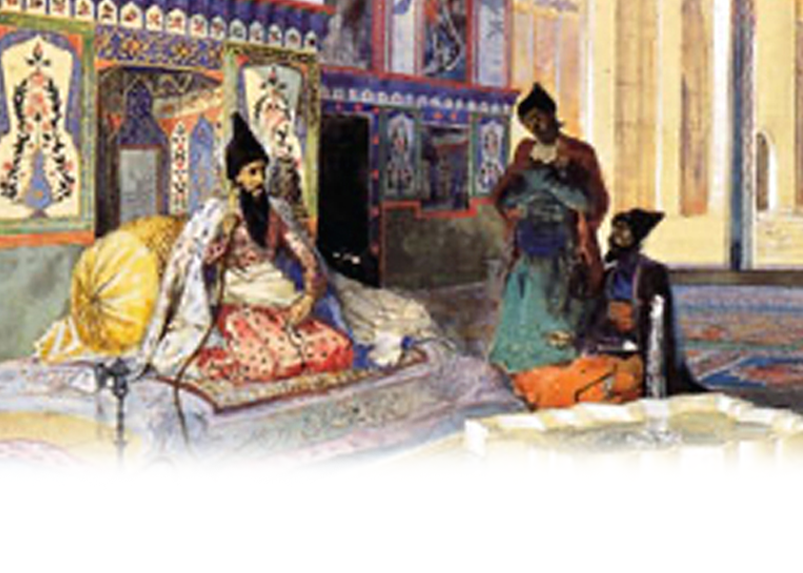
The French traveler and collector Jean Chardin, who visited Iravan in 1673, described the Iravan Fortress as follows: “The fortress is larger than a small town. It has an oval shape, with a perimeter of four thousand paces and consists of approximately eight hundred houses. Only pure-blooded Safavis live there... Three thousand soldiers are assigned to defend the fortress. The governor’s palace is located inside the fortress... On a hill to the north of the fortress, there is also a smaller fort. The distance between them is about a thousand paces. It is reinforced with double walls and artillery. Around two hundred men can be stationed there. Its name is Kechi Fortress.”
European and Russian travelers such as Moritz von Kotzebue, August von Haxthausen, James Morier, Dubois de Montpereux, Henry Lynch, and others described the Iravan Fortress in their writings.
In 1804, the first attack by Russian troops on the Iravan Fortress ended without success.
In 1807, the Khan of Iravan, Huseyngulu Khan Qajar, succeeded in further strengthening the Iravan Fortress with the involvement of French engineers. Cannon foundries and gunpowder factories were constructed within the fortress, additional military units were assembled, and the fortress walls were reinforced.
The second assault by Russian troops on the Iravan Fortress in September 1808 also ended in failure.
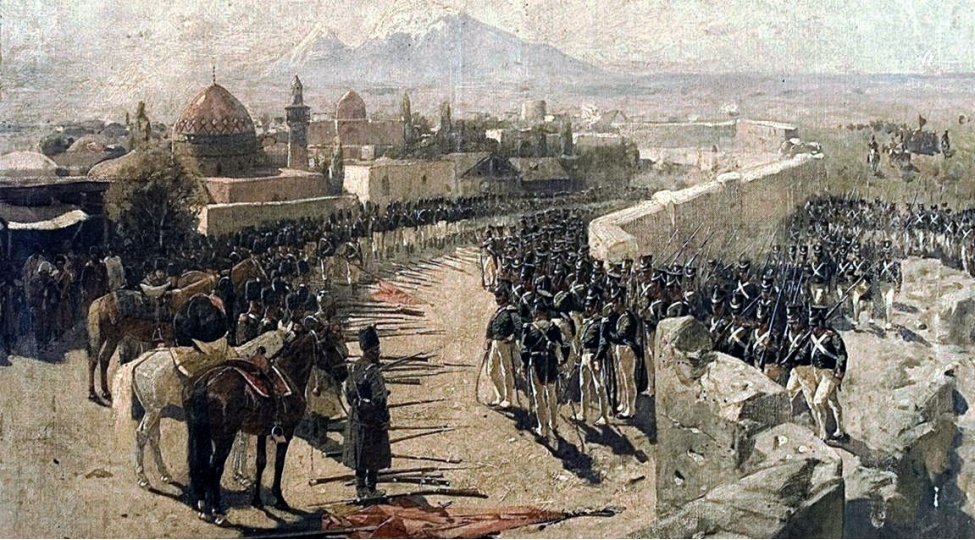
However, on October 1, 1827, Russian forces first captured the southwestern tower of the fortress and then broke through the northern gate, entering the fortress.
The Iravan Fortress had an approximately square shape, measuring 850 meters in length and 790 meters in width, covering an area of about 7 hectares. The double-layered fortress walls stood 10.5 to 12 meters high. One of the single-layered walls ran along a rocky edge washed by the Zangi River.
After the occupation, the Iravan Fortress was declared state property. It retained its status as a military fortification until March 12, 1864. Following its official decommissioning, the Armenians living in the surrounding areas dismantled and removed the stones of the fortress walls and towers. From the 1880s onward, the internal structures and defensive installations within the fortress gradually disappeared.
Today, a model of the Iravan Fortress, created by modern Armenian architects, is displayed at the Iravan History Museum.